






















The Troubling Trend of Online Beta Reading Scams

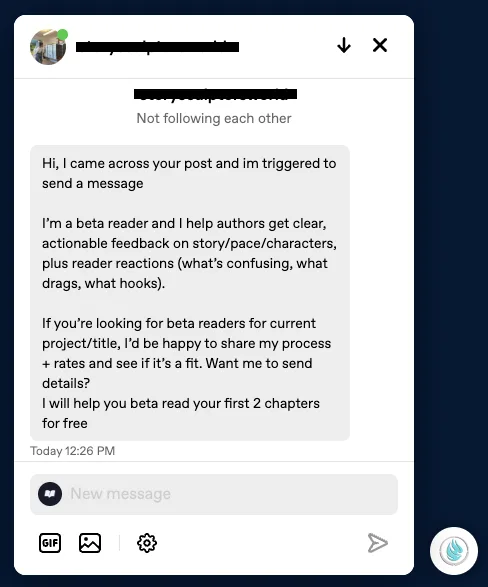
If you’ve spent any time on writing social media lately, you’ve probably noticed a surge of accounts offering beta reading services. They’ll pop up in comments on posts you’ve followed. Maybe they’ve even commented on your posts, or slid into your DMS. On our Tumblr blog, I get a scam comment under almost every post, and the inboxes on most of our socials are inundated by messages offering to beta read my work.
The more of them you see, the more you start to notice how similar they all sound. They’ll often pick out a key word from your post and parrot it back to you for the illusion of personalisation, or they’ll just gush about how your content simply compelled them to reach out.
As beta reading has become an openly recognised step in the writing process, scammers have taken notice, and done what they do best. Scam. Writers eager for feedback make tempting targets, so understanding how these scams operate is the first step toward protecting both your work (and your wallet).
What legitimate beta reading looks like
Before we dive into the warning signs of who might be a scam, it’s worth discussing what genuine beta reading looks involved.
A beta reader is typically a volunteer, often a fellow writer or avid reader, who reads your manuscript before publication and provides feedback from a reader’s perspective. They’re not professional editors, and they don’t claim to be. What they offer is the view of a genuine reader who is experiencing your story for the first time.
Legitimate beta readers are motivated by a love of reading, a desire to support fellow writers, or the hope of receiving reciprocal feedback on their own work.
Most beta readers don’t charge fees. I have never used a paid beta reader, and never will, but I have done reciprocal beta reading exchanges with other writers. With that said however, I do know lots of writers who may offer a small fee to their beta readers in order to compensate them for their time, but these have been discretionary.
You will hear some arguments that are pro paid beta reading services. I’m not claiming they’re all a scam, only that in my experience, when it’s a paid service it comes with expectations beyond what a beta reader is there to do. It puts pressure on the reader to read closer than they would if they were simply reading a book for enjoyment (defeating the object of beta reading), and can often times inflate the expectation of the author for the detail of the feedback they should receive.
A beta reader isn’t there to spell check or copy edit. They’re not there to pick up on every tiny error. They’re there to read and to tell you how and why they did or didn’t enjoy your work. A beta reader shouldn’t be expected to have professional expertise. The relationship is collaborative, not transactional in the way a professional editing service would be.
This is precisely what makes the current wave of scams so insidious. They exploit writers’ genuine need for feedback while mimicking the language of legitimate beta reading communities.
The anatomy of a beta reading scam
Scammers targeting writers spend a lot of time in writer spaces. They have seen where there is a need, and have specifically targeted those areas. Here are the most common tactics currently flooding social media platforms.
The “professional beta reader” pitch
You’ll often see accounts advertising themselves as “professional beta readers” or “certified manuscript consultants.” They promise comprehensive feedback, often with specific turnaround times and detailed breakdowns of what their analysis will cover.
I’m going to say this as loudly as I can for those in the back. There is no such thing as a certified beta reader. Beta reading isn’t a profession with credentials or qualifications. A beta reader should just be a reader who can give you a reader’s-eye view of your work. When someone uses official-sounding titles to justify fees, they’re inventing an authority that doesn’t exist.
AI-generated feedback mills
A lot of beta reading scams are run by bots who will feed your manuscript into AI-generated feedback mills. They’ll collect your manuscript, run it through AI tools, and return generic feedback dressed up as personal analysis. The writer pays for what they believe is human insight, only to receive the kind of surface-level observations any chatbot might produce.
These operations can work with a volume and speed that would be impossible for any individual reader providing genuine feedback and is the type of scam you’re most likely to see as they’re the most prolific.
The disappearing reader
Some scammers simply take your manuscript and vanish. They may have collected payment upfront, or they may be harvesting manuscripts for less obvious purposes. Either way, you’ll be left without feedback and without recourse.
Bait-and-switch services
A particularly frustrating variant involves accounts that offer free or low-cost beta reading, then pressure writers into purchasing expensive “editing packages” or “publishing consultations” once they’ve read the manuscript. The beta reading was never the point, it was just a foot in the door.
Red flags that you should look out for
So, how can you tell the difference between a genuine offer of beta reading and a potential scam? While there’s no warning sign we can point to that is 100% definitive, I’ve put together a list of red flags that should at least prompt you to do some due diligence and research the person reaching out.
Overly formal language
In my experience, most beta readers come from genuine exchanges. You may have someone in your following who is excited by your work, or someone who has interacted with you in some way before who might offer to beta read when the time is right. You might also be a part of a reciprocal exchange community where you read each others work.
Even if you put out a call for beta readers, you’ll usually be able to tell a bot from a human simply because of the way they will speak to you. If the language is far too formal or robotic, this isn’t a guarantee it’s a scam, but it’s worth at least a closer look to be sure.
Unsolicited contact
Getting a message out of the blue is probably the most significant red flag. Legitimate beta readers rarely cold-message strangers to offer their services.
If someone you’ve never interacted with suddenly appears in your DMs promising to read your manuscript, proceed with extreme caution (especially if the offer is unrelated to the content you just put out).
Guaranteed outcomes
If a beta reader is over-promising, this should absolutely raise your suspicions. No beta reader can promise that their feedback will help you secure an agent or land a publishing deal. Anyone making these claims is selling something other than honest feedback.
Pressure tactics
Scammers often create artificial urgency, like limited-time offers, claims that they’re “only taking three more clients this month,” or suggestions that your manuscript needs immediate attention. Genuine beta readers understand that writing operates on its own timeline, the same way that writers need to understand the same of beta readers.
Fun fact: only a handful of the beta readers you ask to read your manuscript will ever actually bother reading it. It’s a voluntary position, so this is normal, and just part of the process. Beta reading works on an “I’d love you to read this, but no pressure” basis. Pressure coming from authors to their readers is already poor form, but a massive red flag if it comes from the other way.
Vague or non-existent online presence
If you’ve never interacted with a person before and they have no online history, it’s best to be wary. Before looking closer at any beta reading offer, look for evidence that this person exists within the writing community. How old is their social account? Do they have a history of posts about writing? Do other writers engage with their content?
An account that appeared last month with no apparent connection to the writing world probably needs to be treated with caution.
Immediate requests for payment
While some beta readers can charge modest fees for their time, most will engage in conversation first, discussing your genre, their reading preferences, and mutual expectations. Someone demanding payment up front before they’ve even asked what your book is about is probably not acting in good faith.
Personally I’m wary of all beta readers who read for pay, but that doesn’t make them all a scam. So the nature of the conversation you have with your reader is something you’ll need to consider for yourself. But an up front request for money should be something that at least prompts you to be a little more careful.
I’ve said it once, and I’ll say it again. If money is involved, you should never work without a contract. Contracts protect everyone, and are such an important part of any business relationship. They set up the expectations from both parties, and ensure everyone is on the same page. And the added benefit is that it actually helps weed out those who are not acting in good faith. If someone isn’t willing to exchange contracts, there’s something dodgy going on and you can walk away safely before taking it any further.
Finding beta readers you can trust
So where should you look for legitimate beta readers?
Writing communities still remain the most reliable source, despite the proliferation of scams. Social media, writing groups, and writing organisations often have established systems for connecting writers. For instance our Discord community has channels dedicated to feedback and beta reading requests, and I’m a big fan of Scribophile, an entire website dedicated to reciprocal feedback and use them for all my projects.
Reciprocal arrangements are often the easiest to find. If you’re part a writing community already, then you can find beta readers by offering to read in exchange. It’s a mutual investment in each other’s work, and the risk of scams drops significantly when both parties are active participants.
If you have a social media following or are active in reader spaces who share a love of the same genre, then this is a great place to reach out for beta readers. The best beta reader is one who is already interested in similar books to the one you’re writing, so with a good hook, you can often find volunteers (even strangers), willing to read your work and give their thoughts.
You can use personal connections, but for beta reading, I’d be a bit more discerning here. Friends and family might be willing, but they might not always be the best fit. If your mother reads exclusively spy thrillers, but you’ve written a romantic comedy, then she probably isn’t going to be the best beta reader for your work as she isn’t your target audience. But if your cousin’s favourite author is Emily Henry, and he’s keen to read your novel, then you’re on to a winner!
The bigger picture
The proliferation of beta reading scams reflects a broader issue facing writers in the digital age. Social media has democratised access to writing communities in wonderful ways, but it has also created new vulnerabilities, especially in a post-GenAI world. Scammers prey on the fact that writers are often working in isolation, and uncertain about the “right” way to navigate their writing journey.
Every writer, at some point, has felt unsure about some part of the writing process. The antidote is community. Writers who connect with each other, share information about their experiences, and approach offers with healthy skepticism are far less vulnerable to exploitation. The writing world has always been built on writers helping writers, and readers helping writers.
Look for beta readers. Welcome feedback. Take the brave step of sharing your work! Just do it with your eyes open, your instincts engaged, and your community at your back.