What are some reliable, free online sources for historical research?
| by Pamela Koehne-Drube | Ask Novlr, Writing
“What are some online historical sources that are reliable and free to use? I am currently losing my mind over this. I’ve been looking into the history of the Aztec Empire. However I’m not sure which is accurate and which is not. It’s genuinely a pain.”
All sources are biased, it's the nature of authorship. There's a reason that history is an arts subject and not a science. When someone writes their history, they have the bias of their personal experience, but we also bring that same bias to our interpretation of sources. There is some degree of accuracy that can be expected, but it's always important to remember that interpretation is subjective.
But with that said, now that the internet is such a big part of our lives, it becomes more and more difficult to discern what is actually researched and what is simply articulated and put out into the world. On the internet, anyone can publish anything, and history in particular gets rewritten, romanticised, and politicised more than almost any other subject.
I started my career as a professional historian, and I can tell you firsthand how frustrating it has been to see this trend. People with no expertise or knowledge present themselves as experts, allowing misinformation to flourish, and it can be so difficult to filter what is genuine research, vs what is just someone spouting an uninformed opinion. This gets especially frustrating when so much academic research is hidden behind a paywall. The good news is that there's a real, free, findable layer of reliable historical material out there, once you know where to look and how to tell it apart from the noise.
How to read sources
Whatever period or place you're researching, the same problem rears its head: most of what's been written comes filtered through whoever happened to be holding the pen. Your Aztec Empire research runs into this constantly, because so much surviving material on the period was written by Spanish chroniclers centuries after the fact, with their own biases and agendas.
The same distortion shows up everywhere. Tudor history gets filtered through Victorian romanticism. Colonial history gets filtered through the colonisers. Whatever era you're writing in, someone got to the record before you did, and they weren't neutral.
The same goes for secondary sources. Everyone who writes on any specific topic has a reason for doing so. Somewhere within their work is their thesis statement: the single takeaway they want a reader to walk away with. That takeaway will inform everything they write. Ideally, they'll have a good-faith interpretation that supports it, but very often you'll see cherry-picked data or misrepresentations to uphold whatever they want you to take away from their work.
Whenever you read any piece of research, don't take it at face value. For any source you're reading, on any topic, ask yourself: Who wrote this, when, and what did they want you to believe? That single question filters out an enormous amount of unreliable material and saves you hours of unusable research.
Where to find sources
Newspapers and magazines
Reputable newspapers and magazines can be a real asset for historical research, especially for accessible overviews, archaeological discoveries, or tracking how historical understanding has changed over time. Publications like Smithsonian Magazine, National Geographic, and the archives of major newspapers often have well-researched, editor-reviewed pieces written with historians as sources.
The catch is that "reputable" doesn't always mean "unbiased," and even excellent outlets have an editorial lean or a house style that shapes how a story gets told. This is where bias-checking sites can be extremely useful.
Media Bias/Fact Check is a website that rates outlets for both political leaning and factual reliability. It will tell you really important information like their bias and credibility, their likelihood factual reporting, their popularity (so how far you can expect those ideas to have spread in the general populace), and any relevant information like who they are owned and/or funded by.
Tools like this tell you what lens an article was likely written through, so you can read it with that in mind rather than absorbing it as neutral fact. A useful habit is to find the same claim reported in two or three outlets that have a good reputation for factual reporting. If they agree on the basic facts, you're probably safe to trust it.
Go straight to where historians publish
Academic journals are the gold standard here. This is where historians and researchers present their research to other historians and researchers, which means the material has usually been peer-reviewed (checked over by other experts before publication). It's slower and denser reading than a magazine article, but it's about as close as you can get to "this has been checked."
You don't need institutional access to read a lot of it, and you don't need to be based in any one country either:
- JSTOR offers free individual accounts that give you registered access to read a set number of articles each month at no cost. But a lot of state and national libraries will offer full access to JSTOR with a reader number of membership if you can apply for one.
- University library search engines will offer an easily-accessible way to find journal articles that come ready-made with a peer-review stamp. While you'll not usually be able to find the article available at that university without a university login, what it can do is give you the name of the academic who wrote it. Most academics are more than happy to provide you a copy of their articles for research if you reach out. And the other thing a university library search can help you do is check for the peer-review status of something you've found somewhere else.
- Google Scholar is worth treating as a search engine rather than a library. It surfaces academic papers and books across many repositories. Not all journals are peer-reviewed, however so it's worth double-checking that (something that the university search can be really useful for).
- The Directory of Open Access Journals (DOAJ) indexes journals that are free to read by design, with no paywall at all.
- National libraries are an underused option, and most offer some form of free public access. In the UK, the British Library and bodies like the National Library of Wales and the National Library of Scotland hold enormous research collections, much of it searchable and readable online at no cost, with free reader passes available for anyone who lives within their catchment that offer access for in-person borrowing and wider journal access to repositories like JSTOR (I'm not longer an academic associated with a university, but my National Library of Wales reader number gives me full access to JSTOR, for example. Without that, I'd have to pay their access fee). In the US, the Library of Congress does something similar. Most countries have an equivalent national (or state) library, and it's always worth checking what yours offers before assuming you can't get in.
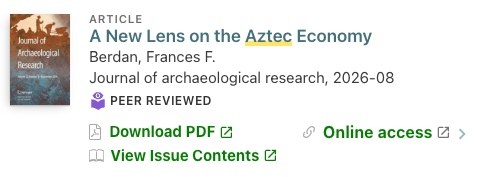
I've taken a screenshot of a Monash University Library search above, that shows an article listing with the Peer Reviewed stamp so you know what to look for.
A small tip that saves a lot of frustration: search for the specific thing you want to know rather than the broad topic. Journal articles are narrow by nature, and a specific search gets you to the right one faster than a broad one.
Other free general history resources
Beyond journals, there's a solid tier of free resources built specifically to be reliable references:
- The Internet Archive (archive.org) has an enormous free library of digitised books, including many older academic texts now in the public domain.
- The Library of Congress and the Digital Public Library of America both offer searchable digital collections, including primary documents and historical maps, on the US side.
- The British Library's digital collections, The National Archives (Kew), and the digitised holdings of the National Library of Wales and National Library of Scotland do the equivalent job for British and UK-adjacent history, with a huge amount of source material freely browsable online.
- World History Encyclopedia is written and reviewed by historians and academics, and is a properly good starting point for orientation before you go deeper into any topic.
Find the specialist archive for your specific period or place
General resources will only take you so far. Almost every historical period, region, and culture has a dedicated body of specialists who maintain focused archives, journals, and societies, usually with a free or low-cost public-facing arm. Once you know your topic, it's worth spending twenty minutes hunting for the equivalent in your specific area.
For the Aztec Empire, that looks like:
- The Florentine Codex, compiled by Bernardino de Sahagún with Nahua scholars in the 16th century, is one of the richest surviving records of Mexica life, and digitised versions are freely available online through university and library partnerships. It's a primary source, which makes it invaluable, but it was still produced under Spanish colonial oversight, so it's worth reading with an eye on whose voice is doing the framing.
- FAMSI (Foundation for the Advancement of Mesoamerican Studies) and Mesoweb are both dedicated specifically to Mesoamerican archaeology and history, built by and for specialists in the field.
- INAH, Mexico's national institute of anthropology and history, publishes research and maintains resources tied directly to Aztec and Mexica heritage sites.
If you were researching the Tudor court instead, you'd be looking at the National Archives' State Papers and the Tudor-specific societies that catalogue and translate them. If it's the Roman Empire, you'd want the Perseus Digital Library or the Association for Roman Archaeology. The names change, but the principle doesn't: find the specialists who've made your specific patch of history their life's work, and let them do the heavy lifting.
Question every source
When you're not sure whether to trust something, a few questions can help you out:
- Who wrote it, and what's their expertise or affiliation?
- When was it written or last updated (scholarship changes over time — the older an article is, the more likely it is to be outdated)?
- Does it show its own sources, or just assert things without backing it up?
- Do other reliable sources agree with it?
That last one matters more than any single source being "perfect." Research is all about triangulating: reading enough sources that you can see where they overlap and where they don't, and treating the overlap as the foundation you build on.
The takeaway
Research is the hard, slightly unglamorous work of writing, and the fact that you care about getting it right is amazing and makes my historian heart glad. You don't need certainty on every single detail before you start writing, but you do need sources you could defend if someone asked where a fact came from, and a habit of checking claims against more than one place before you trust them.
Even professional historians argue about most periods of history. That's why we still write books and continue to research. Our picture of the past changes and develops as we learn more, a shifting pattern of best fit, rather than a claim of objective truth.
Once you've got the history sorted in your own head, the next challenge is usually getting it onto the page without it reading like a lecture, and that's a whole skill of its own worth thinking about, too. For now, though, bookmark a couple of the free resources above, keep a running note of where each fact came from as you go, and let yourself feel good about how much more solid your research is about to become.